









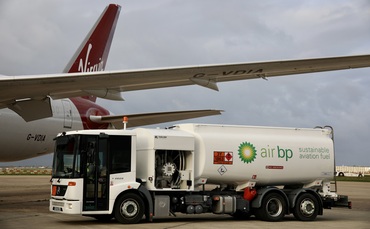
Virgin Atlantic’s “world first” 100 per cent sustainable aviation fuel (SAF) powered flight from London Heathrow to New York’s JFK has taken off today.
Virgin Atlantic said the Boeing 747 Dreamliner had been fuelled with a blend of 88 per cent hydroprocessed esters and fatty acids (HEFA) made from waste fats provided by Air BP and 12 per cent synthetic aromatic kerosene (SAK) made from plant sugars and supplied by Virent.
Intended to demonstrate SAF’s potential as a drop-in replacement for fossil derived jet fuel, and its compatibility with today’s engines, airframes and fuel infrastructure, the ‘Flight100’ project also provides an opportunity to research the fuel’s effects on contrails and will provide data to help implement pollution forecasts in flight planning processes.
Shai Weiss, chief executive at Virgin Atlantic, said the Flight100 project proves that SAF can be used as a safe, drop-in replacement for fossil-derived jet fuel.
“It’s taken radical collaboration to get here and we’re proud to have reached this important milestone, but we need to push further,” he said. “There’s simply not enough SAF and it’s clear that in order to reach production at scale, we need to see significantly more investment. This will only happen when regulatory certainty and price support mechanisms, backed by Government, are in place. Flight100 proves that if you make it, we’ll fly it.”
SAF currently meets less that one per cent of UK jet fuel demand and critics have questioned the ability of the nascent industry to deliver low emission fuels at sufficient scale and competitive prices.
Moreover, given international standards do not yet permit more than a 50 per cent blend of synthetic fuel with regular jet fuel, today’s flight required a specific permit from the UK Civil Aviation Authority.
However, Sheila Remes, vice president of environmental sustainability at Boeing, one of the partners in the Flight100 consortium, hailed today’s flight as a “significant milestone”.
“This flight is a key step toward our commitment to deliver 100 per cent SAF-compatible airplanes by 2030,” she said. “As we work toward the civil aviation industry’s net-zero goal, today’s historic journey highlights what we can achieve together.”
Virgin Atlantic and its consortium were awarded up to £1m of UK Government funding in December 2022 following a challenge from the Department for Transport to support the industry in achieving the first transatlantic flight on a commercial aircraft powered by SAF.
Transport Secretary Mark Harper, who boarded the flight alongside Weiss and Virgin’s founder, Sir Richard Branson, said: “Today’s 100 per cent SAF powered flight shows how we can decarbonise transport both now and in the future, cutting lifecycle emissions by 70 per cent and inspiring the next generation of solutions.
“This government has backed today’s flight to take-off and we will continue to support the UK’s emerging SAF industry as it creates jobs, grows the economy and gets us to Jet Zero.”
However, green groups expressed scepticism at the ability of SAFs to deliver sustainable and scalable emissions reductions across the aviation industry.
Cait Hewitt, policy director at the Aviation Environment Federation, described the idea that today’s flight moves the world closer to “guilt free flying” as a “joke”.
“SAFs represent around 0.1 per cent of aviation fuel globally and will be very hard to scale up sustainably,” Hewitt said. “The other fact that often gets obscured by the industry is that SAFs emit as much CO2 as kerosene at the tailpipe. Airlines want to argue that because alternative fuels are made from waste plant matter, this offsets the emissions from the flight. But that’s misleading.
“Plant waste represents a historic capture of CO2 – from the process of growing – that’s happened anyway. Turning it into aircraft fuel means putting more CO2 in the air today. Hopefully, we’ll have better technological solutions in future, but for now, the only way to cut CO2 from aviation is to fly less.”
Paul Thompson, head of renewable transport fuels at the Association for Renewable Energy and Clean Technology, welcomed the flight, but stressed that SAF is not a “silver bullet” for delivering long term decarbonisation.
“REA welcomes this first ever transatlantic flight using SAF today and congratulate all the project partners,” he said. “The decarbonisation of the aviation industry is a key sector to meet Net Zero and having been very closely involved with our members and Government on developing policy in this field we welcome this landmark.
“However, in the longer term we know this is not a ‘silver bullet’ and a mix of technologies, such as zero carbon hydrogen and electrification, will be necessary, alongside addressing the elephant in the room of ever growing aviation use.”
In related news, zero emission aviation pioneer ZeroAvia today announced it has signed an agreement with newly launched airline Ecojet for up to 70 hydrogen-electric, zero-emission engines.
The deal provides a major boost to Ecojet’s plans to begin operations in 2024 with conventionally powered aircraft operating routes to and from Edinburgh, before then converting its fleet to become ‘the world’s first electric airline’.
Val Miftakhov, founder and CEO at ZeroAvia, said: “Clean aviation will mean increased regional air travel and new routes, Ecojet can capitalize based on their clear focus on low-emission travel. The UK government’s Jet Zero Strategy has set a great example for the world to follow, but the UK can go much further by being early to act and introducing some of the first zero-emission routes in the world.”
Dale Vince, founder of Ecojet, said: “We don’t have to give up flying to live a green lifestyle or to get to net zero as a country – and this is big news. The technology is here now and the planes are coming very soon – carbon free, guilt free flying is just around the corner. And although aviation is responsible for only a small part of all global emissions, it occupies a far bigger space than that in our psyche. The hearts and minds value of this new opportunity outweighs the carbon issue significantly. It shows that everything we need to do, can be done, with a low to zero carbon footprint. And that is big news and a big encouragement to us all.”
The deal comes a day after ZeroAvia announced it has completed a $116m funding round to support its plans to deliver commercial zero emission aricraft from 2026.
Want to understand what is going on at the cutting edge of sustainability? Check out BusinessGreen Intelligence – the premier information for professionals focused on the UK’s green economy.