











Image:
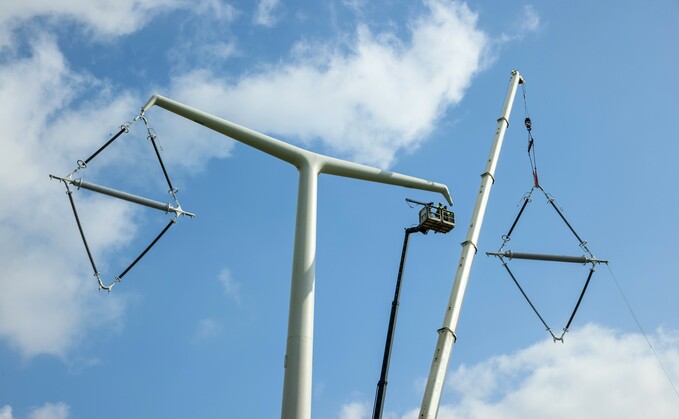
T-pylon diamond insulators being installed on Hinkley Connection Project Credit: National Grid
National Grid has today announced it is bringing forward the grid connection date for up to 20GW of “shovel ready” clean energy projects in England and Wales by up to five years.
The grid operator said 19 battery energy storage projects boasting around 10GW of capacity will be offered grid connection dates averaging four years earlier than their current agreement following the adoption of a new approach which removes the need for non-essential engineering works prior to the connection of storage sites to the transmission network.
Moreover, an additional 10GW of planned capacity on the Midlands, South West of England and South Wales distribution networks will see grid connection dates brought forward by up to half a decade.
Around 10GW of the planned clean energy projects – mostly batteries and batteries co-located with wind or solar – are set to be offered expedited connections in the new year.
According to its announcement, National Grid has already been in contact with more than 200 projects interested in fast tracking their connection dates – with 16 expressing an interest in connecting in the next 12 months and another 180 looking to connect within two to five years.
The new approach to storage project connections comes amid an extensive review of the connections pipeline designed to accelerate the connection process and tackle so-called “zombie projects” in England and Wales which have been awarded grid connection dates but are now unlikely to proceed.
Traditionally, National Grid carries out network reinforcement before a project is connected to the grid, sometimes adding years to project development timetables. The approach is based on the assumption that batteries would charge at times of peak generation and export when generation is low, potentially exacerbating grid system peaks and constraints.
However, the grid operator will now offer selected schemes a transmission connection before network reinforcements are made based on an agreement that operator can adjust a battery’s behaviour in certain operating conditions to reduce system impacts when necessary.
Alice Delahunty, president of National Grid Electricity Transmission, said it was committed to speeding up grid connections and creating a “fit for the future” process for plugging projects into the grid.
“Bringing these battery projects forward is one of a range of actions that our electricity transmission business is delivering alongside the system operator and wider industry to unlock clean energy capacity in England and Wales,” she said.
“We’re really encouraged by the recognition these early joint steps by our industry are receiving. They’re paving the way for the more fundamental connections reform that we’re collectively working with government and the regulator to deliver to keep Britain on track for a secure, affordable and net zero energy system.”
The announcement comes off the back of recommendations from Electricity Networks Commissioner Nick Winser and a series of targeted reforms from the National Grid Electricity System Operator (ESO) to tackle a backlog featuring a 95GW pipeline of energy storage schemes and in the region of 200GW of generation projects. Clean energy developers have long warned that planning restrictions and grid connection delays are one of the main barriers to delivering on the government’s goal of operating a net zero power system by 2035.
Julian Leslie, the ESO’s head of networks and chief engineer, said he was pleased to see tangible delivery against one of the key points in its five-point plan to speed up connections to the transmission grid for battery and storage projects.
“We’re evolving our network and taking the lead on speeding up connections to make our power system fit for the future, to deliver net zero and keep clean power flowing to the growing number of homes and business across Great Britain, fuelling our economy,” he said.
“The ESO will continue to work with Great Britain’s Transmission and Distribution Owners, Ofgem, Government and the wider industry to solve one of the key challenges facing our energy system today.”
Keep up to date with all the latest green business news by signing up to the free Daily and Weekly BusinessGreen Newsletters