











Image:
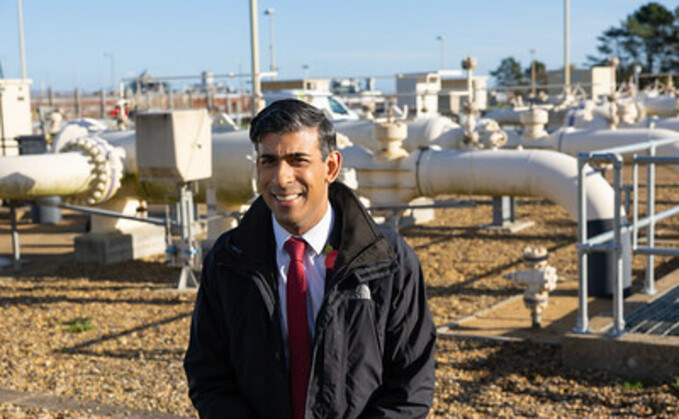
The Prime Minister Rishi Sunak at Bacton Oil & Gas Terminal in Norfolk this week | Credit: Simon Walker / Downing Street
The government has officially introduced controversial legislation to Parliament that would require new North Sea oil and gas drilling licenses to be handed out on an annual basis, while stressing that these licensing rounds would be subject to “stringent new emissions and imports tests”.
As trailed in Tuesday’s King’s Speech, the Offshore Petroleum Licensing Bill aims to “boost the UK economy, energy security and the transition to net zero”, the government said.
But Opposition Parties and green groups have continued to argue that further drilling in the North Sea will more likely hinder both energy security and the net zero transition. They have also warned that the legislation is unnecessary, given authorities have frequently issued oil and gas drilling licenses on an annual basis under the current legislative regime.
But unveiling the legislation yesterday, the government argued statutory measures were needed to ensure more regular licensing rounds take place going forward, insisting the approach would increase investor confidence in the UK’s “vital” North Sea oil and gas industry.
It also stressed that any new drilling licenses would be subject to two stringent new tests being met: firstly, that the UK is projected to remain a net importer of oil and gas; and secondly that carbon emissions associated with the production of UK fossil gas “must be lower than the average of equivalent emissions from imported liquefied gas” (LNG).
BusinessGreen has sought clarification from the government as to whether the first test on the UK’s import projections would apply to when a drilling license is handed out, or when the project is expected to begin operations.
The government also continued to argue that supporting continued production of oil and gas in the UK would help to reduce reliance on higher-emissions imports, claiming that domestic gas production has around only a quarter of the same carbon footprint of imported LNG.
However, earlier this week Claire Coutinho, the government’s Energy Security and Net Zero Secretary, conceded that new domestic fossil fuel production projects were unlikely to have any impact on consumer energy bills.
Critics of the government’s approach also point out that the cheapest, quickest and greenest means of boosting the UK’s energy security is to ramp up clean energy capacity, while boosting energy efficiency and accelerating electrification of home heating and road transport.
Introducing the Bill to Parliament yesterday, the government stuck resolutely to its position that it was possible to support continued domestic oil and gas production while growing the economy and still delivering on the UK’s net zero target “in a pragmatic and proportionate way”.
“The UK has cut its emissions faster than any of its peers,” said Coutinho. “But as the independent Climate Change Committee acknowledges we will need oil and gas even after we reach net zero in 2050.”
“As energy markets become more unstable it’s just common sense to make the most of our own homegrown advantages and use the oil, gas, wind and hydrogen on our doorstep in the North Sea. Rather than importing dirtier fuels from abroad, we want to give industry the certainty to invest in jobs here and unlock billions of pounds for our own transition to clean energy.”
At present the oil and gas industry is estimated to support around 200,000 UK jobs while adding around £16bn to the economy, although the sector also receives tax breaks and indirect subsidies that have been estimated to amount to billions of pounds each year.
The unveiling of the legislation follows the publication of UN-led research yesterday which warned the world’s top 20 oil and gas producing nations – including the UK – are collectively on course to blow the carbon budget for limiting global warming to 1.5C through their current plans to expand fossil fuel production.
Labour said it plans to force a debate in Parliament over the new legislation, in a bid to draw attention to its concerns that further oil and gas licensing will do little to help cut household energy bills and could undermine the UK’s climate targets.
“It is a stunning admission from this government that, during the worst energy bills crisis in generations, their flagship King’s Speech energy policy won’t even take a penny off energy bills,” said Labour’s Shadow Energy Security and Net Zero Secretary Ed Miliband.
Keep up to date with all the latest green business news by signing up to the free Daily and Weekly BusinessGreen Newsletters.